
The Hidden Value of Property Line Markers During Renovations
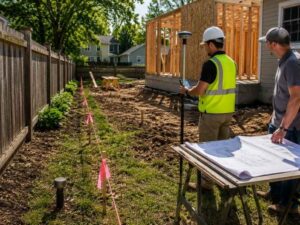 Most homeowners never think about property line markers until a renovation is already underway. That’s usually the wrong time to start looking. Property line markers tell you exactly where your land ends and your neighbor’s begins, and skipping that check before you build can turn a simple project into a costly one.
Check Property Line Markers Before You Build
A renovation plan looks solid on paper, but paper doesn’t account for where your actual boundary sits on the ground. Builders and homeowners often work from a rough sense of the lot, not the surveyed line, and that gap is where problems start.
An addition that creeps a few feet over the line can force a homeowner to redesign, relocate, or even remove part of a finished structure. That kind of mistake costs far more to fix after construction than it would have cost to check beforehand. Locating your property line markers first gives you a real boundary to build against instead of a guess.
Older Neighborhoods Can Have Different Marker Standards
Property line markers in older subdivisions often follow standards that changed decades ago. A neighborhood platted in the 1960s or 1970s might use marker types, depths, or materials that newer surveying practices don’t rely on anymore, which makes them easier to overlook during a renovation.
Some older lots were also replatted or adjusted after the original survey, which means the markers in the ground today might reflect a boundary that shifted since the neighborhood was first built. A renovation that assumes the original 1960s layout still applies can end up working from an outdated line. Checking current markers against the current recorded plat catches that mismatch before it becomes part of your build.
Property Line Markers Help Protect Your Project
A fence, a shed, or a home addition all need to sit inside your actual property line, not just inside the space that looks open. Property line markers give you a fixed, physical reference for where that limit falls, which takes the guesswork out of placing a new structure.
This matters most for projects near the edge of a lot. A shed built two feet over the line might seem harmless until it triggers a permit issue or a boundary dispute during a future sale. Confirming your markers before you break ground protects the project you’re building and the property value attached to it.
Why Property Line Markers Can Be Hard to Find
Grass grows over them. Landscaping buries them. A driveway extension or an old deck installed years ago might sit directly on top of one without anyone realizing it. Property line markers are small, and a yard that’s been mowed, mulched, and rebuilt over the years does a good job of hiding them.
Even homeowners who know roughly where a marker should be often can’t locate the actual pin without digging or probing the ground. Some markers were disturbed during past construction and never reset. Others sit just below the surface, invisible until someone knows exactly where to look. That’s part of why a visual scan of the yard rarely settles the question on its own.
When to Call a Land Surveyor
A land surveyor should confirm your property line markers whenever a renovation involves new construction near a boundary, such as an addition, a fence, a shed, or a detached structure. Many permit offices require this confirmation before approving the work, which makes it a practical first step rather than an optional one.
A surveyor doesn’t just search for existing markers. They can also reset ones that were lost, damaged, or covered over the years, and they provide documentation that holds up if a boundary question comes up later. For any renovation that changes what sits on the edge of your lot, that documentation is worth having before the work begins, not after.
Property line markers do more work than most renovation plans give them credit for. They’re the difference between building with confidence and building on an assumption, and that difference tends to show up right when you can least afford it.
Frequently Asked Questions
What are property line markers?
Property line markers are physical points, often metal pins or concrete monuments, that a surveyor places at the corners and boundary changes of a property. They mark the exact legal edge of a lot on the ground, separate from any fence or landscaping feature.
Can property line markers disappear over time?
Yes. Grass, landscaping, and past construction can bury or shift a marker over time, and lawn equipment or digging can damage one without anyone noticing. A marker that’s still legally valid can become physically hard to see or reach.
How can I find my property line markers?
A metal detector or probe can help locate a buried marker if you know roughly where it should sit, but the most reliable way is to have a surveyor confirm the exact position. They can also replace a marker that’s missing or damaged.
Do I need property line markers before building a fence or addition?
In most cases, yes. Confirming your markers before construction helps you avoid building over the line, which can create permit issues or force changes to a finished structure. Many local permit offices require this step before approving renovation plans.
Why are property line markers important in older neighborhoods?
Older neighborhoods sometimes have markers set under different survey standards than current practice uses, and some lots were replatted after the original survey. Confirming today’s markers against the current recorded plat helps avoid building against an outdated boundary line.
For a free land surveying quote, call us at (954) 250-5780 or send us a message by going here.
Posted in land surveying, land surveyor | Tagged boundary survey