
Why Property Buyers Should Review Easements Before Planning a Pool
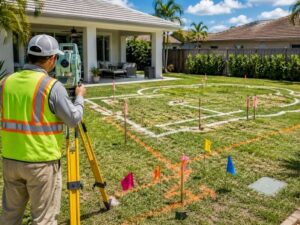
Pool permits get denied. Construction stops mid-dig. Contractors walk off the job because the excavation hit a utility line nobody knew was there. All of these situations share one cause: the buyer never checked the easements before drawing up pool plans. A boundary survey reviewed early in the buying process puts that information on the table before any money gets spent on design or permits. For developers and buyers, this step is not optional if you want to avoid a costly surprise.
Easements Can Affect More Than Property Access
Most buyers think of easements as access issues. Someone has the right to cross your property. That’s where their thinking stops.
Easements do a lot more than that. A utility easement running along the rear of a lot can prohibit any permanent structure within a set width of the easement boundary. A drainage easement in a low-lying area can restrict grading and excavation. A Florida Power and Light easement may prohibit pool installation entirely within its corridor.
In Broward County, residential lots often carry multiple recorded easements from different eras. Drainage easements, utility easements, FPL easements and private access easements can all overlap on a single parcel. Each one has different restrictions. None of them appear on a basic deed. They show up in the recorded title documents and on a current boundary survey.
Buyers who skip that step find out about easements when the permit reviewer sends back a denial.
How Survey Records Help Identify Easement Locations
A boundary survey shows more than the property line. It maps recorded easements against the physical lot so you can see exactly where the restrictions fall.
The survey pulls from recorded plat documents, deed restrictions and title instruments. The licensed surveyor plots each easement on the drawing with its recorded width and origin. You can see whether the easement runs along the rear ten feet of the lot or cuts diagonally through the middle of the backyard.
That drawing is what engineers and pool contractors need to place a pool legally. Without it, they’re guessing. Pool placement decisions made without a current boundary survey regularly run into easement conflicts during the permit review process in Fort Lauderdale and across Broward County.
A survey for pool placement also shows:
- Recorded setback lines from platted right-of-way
- Utility easements with width dimensions tied to the boundary
- Drainage easements that restrict grading and below-grade work
- Private easements from adjacent parcels that cross the property
Each of those items changes where a pool can legally go.
Planning a Pool Around Existing Property Rights
Pool placement is a design problem before it’s a construction problem. Knowing where easements sit before design starts means the architect and pool contractor work within real constraints from the beginning.
Broward County and the City of Fort Lauderdale both require a current survey as part of the pool permit application. The survey has to show the proposed pool location relative to property lines, easements and structures. Submitting a permit without that information triggers a rejection. Getting the survey after design is already finalized often means redesigning.
Some easements allow certain uses and prohibit others. A utility easement may allow landscaping but prohibit structures with footings. A drainage easement may allow a screen enclosure but not a concrete deck at grade. Understanding those distinctions before the pool design is finalized saves real money.
The pool contractor can’t tell you what the easements allow. The title attorney can read the recorded language. The surveyor shows you where the easements sit on the ground. Both pieces are needed before the design locks in.
Avoiding Delays Caused by Easement Conflicts
Easement conflicts found during permit review stop a project. They don’t slow it down. They stop it entirely until someone resolves the conflict.
A pool permitted over a utility easement will get flagged by the permit reviewer. The city or county will require proof that the utility company approves the encroachment or that the pool has been redesigned to clear the easement. Getting that approval from FPL or the water utility takes time, and in some cases the utility won’t grant it at all.
Drainage easements in Fort Lauderdale are often tied to the city’s stormwater system. Building over or into one without approval from the Public Works department can result in a stop-work order on an active construction site. At that point the cost is not just the redesign. It’s the stopped labor, the contractor fees and the permit revision fees on top of the original mistake.
Starting with a boundary survey costs far less than stopping construction to fix an easement conflict that should have been caught before the permit was submitted.
Why Early Research Saves Time and Money
The survey and title review done at the start of a purchase gives a buyer the full picture of what the lot allows. For a developer planning multiple units or a buyer with specific backyard plans, that information is part of the purchase decision.
A lot that looks large enough for a pool may not be buildable for one after setbacks and easements are accounted for. That’s useful to know before closing, not after.
In Fort Lauderdale, pool permit applications require:
- A current boundary survey showing the proposed pool location
- Documentation of all easements affecting the parcel
- Setback calculations tied to the surveyed property line
- Approval from utility easement holders when the pool sits near or within an easement corridor
All of that starts with the survey. Ordering it early in the due diligence period means the buyer has real data when making decisions about the lot, the design and the purchase price.
A pool redesign after permit denial can cost several thousand dollars in revised drawings and resubmission fees. A boundary survey ordered before design starts costs a fraction of that.
Frequently Asked Questions
Can a pool be built inside a utility easement with utility company approval?
Some utility companies will grant a license to build certain structures within their easement corridor, but approvals are not guaranteed and often come with conditions. FPL and water utilities review each request individually. The process takes time, and some utilities won’t approve permanent structures with deep footings regardless of design. Get the survey and identify the easement before assuming approval is possible.
What’s the difference between a platted easement and a deed restriction when it comes to pool placement?
A platted easement appears on the recorded subdivision plat and runs with the land regardless of ownership. A deed restriction is recorded in the deed or a separate declaration and may restrict use in different ways. Both affect pool placement, but they’re resolved differently if you want to modify them. The title attorney reviews the language. The surveyor shows you where each one sits on the lot.
Does a title search at closing show all easements that affect a lot?
A title commitment lists recorded easements as exceptions to coverage. It does not show you where those easements sit on the physical lot or how wide they are. That’s what the boundary survey does. A title search and a boundary survey together give you the complete picture. One without the other leaves gaps.
Can a pool contractor identify easement locations before the survey is done?
No. A pool contractor works from design drawings and site measurements. They don’t have access to recorded title documents and can’t plot easement locations with legal accuracy. Relying on a contractor’s site judgment instead of a licensed surveyor’s drawing is what leads to permit denials and stop-work orders.
How recent does a boundary survey need to be for a pool permit application?
Broward County municipalities generally require a survey that reflects current conditions on the site. If improvements have been added or structures have changed since the last survey, a new one is required. The permit reviewer checks the survey date and may reject an outdated survey regardless of the prior survey’s quality. Confirm the recency requirement with the specific city before ordering.
For a free land surveying quote, call us at (954) 250-5780 or send us a message by going here.